MWM/Deutz TBD232, TBD234, TBD616 and TCD2016 Fuel Injection Pump Repair, Rebuild and Inspection
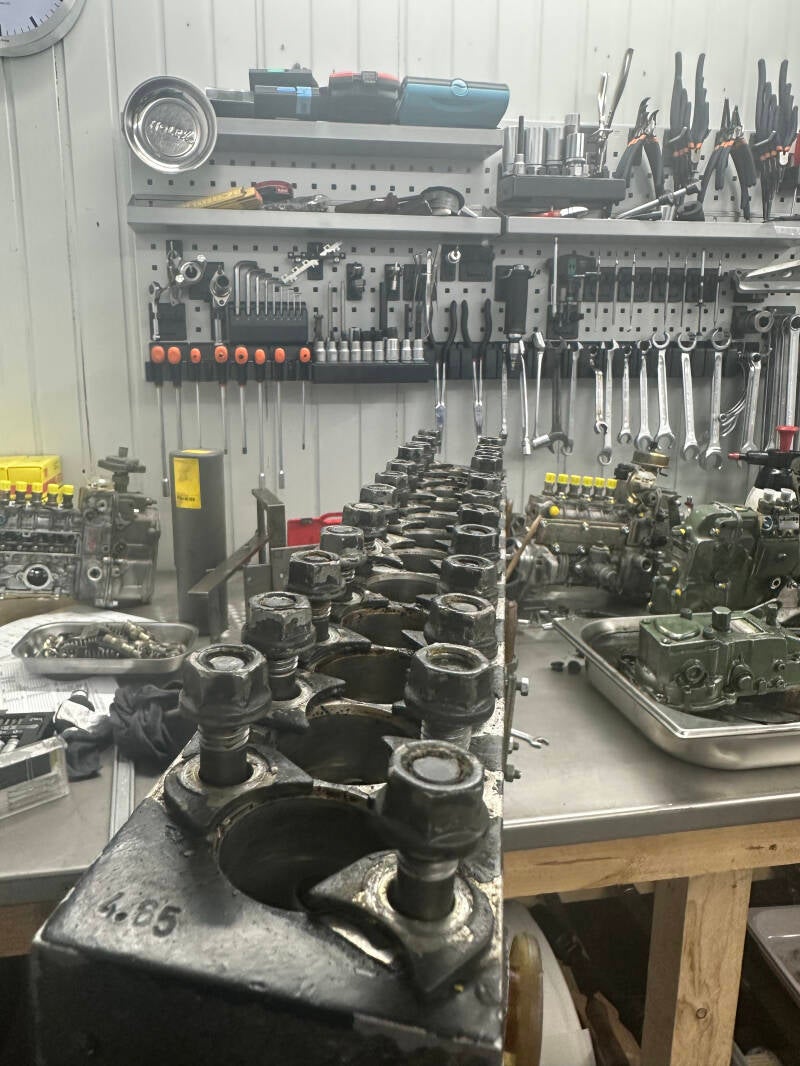
Bosch P Inline Fuel Injection Pumps for MWM/Deutz 232, TBD234, TBD616 and TCD2016
Specialist Overhaul, Repair, Calibration and Spare-Parts Support for RP21, RP21C, RP25 and Related Bosch Inline Injection Pumps
The MWM and Deutz 232, 234, 616 and 2016 engine families represent several generations of robust diesel engines used in marine propulsion, power generation, industrial installations and other heavy-duty applications.
From the early MWM 232 through the TBD234 and TBD616 to the later TCD2016, a clear technical development can be recognised in both the engine design and the fuel injection system.
The basic concept of the mechanically driven Bosch inline fuel injection pump remained in use over several engine generations, while fuel-delivery capability, pump construction, camshaft loading, governing systems, drive arrangements and control technology were progressively developed to meet increasing engine-performance requirements.
With the TCD2016, mechanical high-pressure fuel generation was retained while electronic governing systems were introduced to control fuel quantity and engine speed. DEUTZ workshop documentation describes high-pressure series injection pumps and, on the sixteen-cylinder engine, two pumps mechanically connected by a toothed coupling.
Einspritzpumpen Manufaktur NRW specialises in the technical identification, complete overhaul, dimensional inspection, repair and test-bench calibration of these Bosch inline fuel injection pumps.
Our work includes, in particular:
RP21
RP21C
RP25
and related Bosch injection-pump configurations for:
MWM 232 / TBD232
MWM/Deutz TBD234
MWM/Deutz TBD616
MWM/Deutz TCD2016
For suitable V16 applications, two associated injection pumps can also be tested as a complete system on our dedicated 16-cylinder injection pump test bench with 16 graduated measuring cylinders.
Based in North Rhine-Westphalia, Germany, we support customers throughout Europe and worldwide.
Four Engine Generations – One Continuously Developed Injection System
The MWM 232 can be regarded as an early technical predecessor of the later 234, 616 and 2016 engine generations.
These are not identical engines. They represent a long-term development in which the fundamental design philosophy was progressively adapted to changing requirements.
The TBD232 and TBD234 are documented as water-cooled, four-stroke, direct-injection 60° V-engines. The TBD616 developed this concept further with V8, V12 and V16 configurations, four-valve cylinder heads, high-pressure fuel injection and mechanical or electronic speed governing. The later TCD2016 introduced further electronic monitoring and governing functions.
From the perspective of the injection system, the development can be simplified as follows:
MWM 232 / TBD232
Early generation of large mechanical Bosch inline injection pumps.
↓
MWM/Deutz TBD234
Further-developed mechanical injection-pump systems for higher output, marine and generator applications.
↓
MWM/Deutz TBD616
Well-documented RP21 / RP21C and RP25 configurations for V8, V12 and V16 engines.
↓
MWM/Deutz TCD2016
Mechanical high-pressure inline injection pumps combined with electronic fuel-quantity and speed control; sixteen-cylinder versions use two mechanically coupled pumps.
For overhaul work, this technical development is extremely important.
Injection pumps that appear externally similar may differ significantly in:
- pumping elements
- delivery valves
- camshafts
- cam profiles
- roller tappets
- fuel-delivery characteristics
- governor configuration
- plunger pre-stroke
- injection timing
- rated speed
- engine output
- drive coupling
- and mechanical or electronic actuation.
For this reason, we identify and overhaul every injection pump according to its actual technical configuration, rather than relying only on its external appearance.
RP21, RP21C and RP25
Exact Pump Identification Is Essential
For the later MWM and Deutz engine generations, the designations RP21, RP21C and RP25 are particularly important.
They are not merely catalogue terms.
They are directly relevant to pump construction, installation, adjustment and calibration.
DEUTZ workshop documentation for the TBD616 distinguishes between RP21/RP21C and RP25 and assigns specific Bosch pump configurations, Bosch numbers and plunger pre-stroke values to the different engine versions.
The exact identification of an injection pump therefore requires the complete combination of:
engine model
engine serial number
number of cylinders
RP configuration
complete Bosch pump designation
Bosch part number
MWM/Deutz reference
governor type
rated engine speed
engine output
application
and, where available, the original Bosch or MWM/Deutz calibration data.
MWM 232 / TBD232
The Early Stage of This Engine Development
The MWM 232 engine family represents an early stage in this technical development.
The TBD232 is documented as a water-cooled, four-stroke, direct-injection engine family with 6-, 8- and 12-cylinder 60° V configurations.
Different Bosch inline injection pumps were used depending on engine version, cylinder count and application.
For documented twelve-cylinder installations, large Bosch P inline injection pumps can be identified.
One example is:
PE12P100A520/5RS98
Bosch:
0 401 870 033
Alternative search format:
0401870033
Documented application:
MWM TD232 generator – 900 rpm / 60 Hz
with an RSUV governor.
A further documented TD232 generator version is:
PE12P100-520-5RS98
Bosch:
0 401 870 022
Alternative search format:
0401870022.
For this early engine generation, we do not retrospectively assign an RP21, RP21C or RP25 designation unless it can be confirmed by the original technical documentation or the actual pump identification.
The complete Bosch type designation and Bosch number take priority over assumptions based on the appearance of the pump.
MWM/Deutz TBD234
Further Development for Higher Power and Demanding Applications
The TBD234 continued the development of the water-cooled 60° V-engine concept and is documented in 6-, 8- and 12-cylinder versions.
Different Bosch inline injection-pump configurations were used depending on:
- cylinder count
- engine power
- rated speed
- marine or generator application
- and governor specification.
This makes the complete pump identification particularly important.
TBD234 V8
For D234/TBD234 V8 applications, documented Bosch inline injection pumps include configurations such as:
PE8P120A520/5RS427
Bosch:
0 401 878 108
Alternative search format:
0401878108
The exact pump specification must always be verified against the complete engine and governor configuration.
The designation of the engine alone is not sufficient to determine calibration data or interchangeability.
TBD234 V12
Several Bosch injection-pump configurations are documented for the TBD234 V12.
One known version is:
PE12P120A520/5RS428-1
Bosch:
0 401 870 089
Alternative search format:
0401870089
Another particularly relevant version is:
PE12P120A520/5RS7146
Bosch:
0 402 670 803
Alternative search format:
0402670803
This pump is documented in connection with the TBD234 V12, including applications with RSUV governing.
This demonstrates an important principle:
The engine designation alone does not define the correct injection pump.
The following data must be considered together:
- complete Bosch number
- engine output
- rated speed
- governor
- marine or generator application
- and technical pump version.
MWM/Deutz TBD616
RP21, RP21C and RP25 Injection Pump Configurations
The TBD616 represents a major development stage within this engine family.
It is documented as a modern water-cooled 60° V-engine family in V8, V12 and V16 configurations with four-valve cylinder heads, high-pressure fuel injection and mechanical or electronic speed governing.
For the fuel injection system, DEUTZ workshop documentation provides particularly valuable information and clearly identifies RP21/RP21C and RP25 pump configurations.
TBD616 V8 – RP25
Documented Bosch injection pumps include:
Bosch 0 402 618 808
0402618808
Bosch 0 402 678 829
0402678829
Bosch 0 402 678 828
0402678828
Depending on the exact configuration, the DEUTZ documentation specifies different plunger pre-stroke values, including 4.55 mm and 4.65 mm.
This is important for overhaul and calibration:
There is no single universal adjustment value simply because the pump is identified as RP25.
The exact Bosch pump and engine configuration determine the correct setting.
TBD616 V12 – RP25
Documented Bosch references include:
0 402 610 804
0402610804
0 402 670 810
0402670810
0 402 670 811
0402670811
Different technical versions again use different specified adjustment data.
TBD616 V12 – RP21C
In addition to RP25 configurations, DEUTZ also documents an RP21C version for the TBD616 V12.
A particularly relevant Bosch number is:
0 401 430 015
Alternative search format:
0401430015
The documented plunger pre-stroke for this particular configuration is:
4.95 mm.
This example illustrates why the complete pump identification is essential before any adjustment or calibration work is carried out.
TBD616 V16
Two Injection Pumps – One Complete Fuel Injection System
The TBD616 V16 uses two injection pumps operating together as part of one engine fuel injection system.
Both RP25 and RP21C configurations are documented.
For overhaul purposes, these pumps should therefore not automatically be treated as two unrelated individual units.
Their mechanical position, coupling, control movement and fuel delivery must ultimately work together on the same engine.
TBD616 V16 – RP25
Documented Bosch numbers include:
0 402 618 806
0402618806
0 402 618 807
0402618807
0 402 618 809
0402618809
0 402 678 830
0402678830
The respective configurations and specified plunger pre-stroke values are listed in the DEUTZ workshop documentation.
TBD616 V16 – RP21C
For an RP21C V16 configuration, the following Bosch pump pair is documented:
0 401 408 050
0401408050
and
0 401 438 015
0401438015
For this configuration, the documented plunger pre-stroke is:
4.95 mm.
Why Both V16 Injection Pumps Must Be Considered as One System
A V16 injection system is not simply a collection of two independent pumps.
Both units eventually operate on the same engine and therefore have to work together in terms of:
- fuel delivery
- mechanical basic position
- control movement
- coupling
- injection timing
- and overall synchronisation.
Differences between the two pumps may result in different combustion conditions between the cylinder groups.
Possible consequences include:
- unequal cylinder output
- different exhaust-gas temperatures
- uneven engine loading
- smoke
- increased thermal stress
- poor load response
- and additional mechanical loading.
For this reason, our objective is not merely to overhaul two individual pumps.
Our objective is to restore a matched V16 fuel injection system.
16-Cylinder Test Bench with 16 Graduated Measuring Cylinders
Complete Testing and Synchronisation of V16 Injection Pump Systems
For suitable V16 systems, we operate a specially configured 16-cylinder fuel injection pump test bench with volumetric fuel-delivery measurement through 16 individual graduated measuring cylinders.
Following overhaul, both injection pumps can first be inspected and calibrated individually.
Where the specific pump configuration allows, they can then be:
- mechanically coupled
- operated together
- synchronised
- compared under identical test conditions
- and evaluated as one complete 16-cylinder system.
Every pumping element has its own measuring position.
This allows direct comparison of:
fuel delivery within pump I
fuel delivery within pump II
differences between both pumps
all 16 pumping elements
repeatability over multiple test cycles
the effect of adjustment corrections
control movement
and
synchronisation of the complete assembly
Our objective is not simply to return two individually functioning injection pumps. Our objective is a technically matched and balanced V16 fuel injection system.
MWM/Deutz TCD2016
Mechanical High-Pressure Injection Pumps with Electronic Governing
The TCD2016 represents a later stage in the development of this engine family.
DEUTZ workshop documentation describes a high-pressure fuel injection system using series injection pumps. The documentation states that the eight- and twelve-cylinder engines operate with one high-pressure series injection pump, while the sixteen-cylinder engine uses two. On the V16, the connection between the two injection pumps is provided by a toothed coupling.
The principle of mechanically generated high fuel pressure therefore remained.
The major development took place in the governing and control system.
Electronic Fuel-Quantity and Speed Governing
Electronic governing systems documented for the TCD2016 include:
DEUTZ EMR2 with Heinzmann StG 2040-DP
and:
GAC
The purpose of these systems is to adjust the fuel quantity supplied to the engine by acting on the mechanical injection-pump control linkage.
With the EMR2 system, the actuator converts the electronic control command into mechanical movement of the injection-pump control rod.
The GAC system similarly uses an actuator mounted directly on the injection pump to adjust fuel quantity according to engine load and speed demand.
For technical diagnosis and overhaul, this distinction is important:
High-pressure fuel generation remains mechanical within the inline injection pump, while fuel quantity and engine speed can be controlled electronically.
The mechanical injection pump and the electronic governing system must therefore be assessed separately, while still being understood as interacting parts of the complete engine-control system.
A fault can originate from:
- mechanical wear inside the injection pump
- restricted control-rack movement
- incorrect actuator adjustment
- actuator failure
- linkage problems
- sensor problems
- wiring
- control-unit faults
- or incorrect basic settings.
Technical Continuity Between TBD616 and TCD2016
One particularly interesting Bosch reference is:
0 401 430 015
or:
0401430015
This Bosch number is documented for an RP21C configuration on the TBD616 V12.
Later engine and replacement-part information also associates this Bosch number with TCD2016 applications.
This technical continuity is one of the reasons why we consider the 232, 234, 616 and 2016 engine generations together rather than treating each engine family as an isolated subject.
At the same time, historical workshop documentation and later spare-parts information do not always use identical complete type descriptions.
For this reason:
The original pump nameplate and confirmed engine specification always take priority over a later catalogue or aftermarket description.
Our Overhaul Process for Bosch P Inline Injection Pumps
Complete Technical Assessment – Not Simply Resealing
For us, a professional injection-pump overhaul does not consist of cleaning the unit, replacing seals and making a basic adjustment.
These pumps are mechanical precision systems.
Wear in a single component can affect:
- fuel delivery
- cylinder-to-cylinder balance
- control movement
- governor behaviour
- injection timing
- and the reliability of the complete engine.
Every pump is therefore inspected systematically.
1. Technical Identification and Incoming Inspection
Before dismantling, we document:
- complete Bosch type designation
- Bosch part number
- MWM/Deutz reference
- RP21 / RP21C / RP25 or other confirmed pump version
- engine model
- engine serial number
- number of cylinders
- engine output
- rated engine speed
- direction of rotation
- application
- governor type
- mechanical or electronic actuation
- and available manufacturer test data.
For V16 systems, both pumps are documented individually and subsequently assessed as parts of one complete injection system.
2. Complete Dismantling
The injection pump is dismantled into its functional assemblies.
Depending on the exact pump version, we inspect components including:
- pump housing
- pumping elements
- plungers
- barrels
- delivery valves
- delivery-valve holders
- camshaft
- cam profiles
- rollers
- roller tappets
- bearings
- tappet pins
- bushes
- control rack
- control mechanism
- springs
- shafts
- levers
- governor connection
- pump drive
- coupling components
- sealing surfaces
- and housing fits.
3. Cleaning, Inspection and Dimensional Measurement
After complete cleaning, all functionally relevant components are inspected and measured.
Particular attention is paid to:
- pumping-element wear
- internal leakage
- corrosion
- surface damage
- camshaft wear
- condition of the cam profiles
- roller wear
- roller-tappet wear
- bearing clearance
- delivery-valve condition
- control-rack movement
- fits
- and existing mechanical settings.
A component is not considered serviceable merely because it appears visually acceptable.
The decisive criteria are:
dimensional accuracy, surface condition, wear and actual technical function.
4. Spare-Parts Supply
Original spare-parts availability for many pumps from these engine generations is becoming increasingly limited.
Individual components may have been discontinued or may only remain available from historical stock.
Depending on the project, we source:
- original spare parts
- New Old Stock
- used original components
- donor pumps
- historical manufacturer documentation
- and suitable reference components.
A used component is not automatically installed into a customer pump.
It may instead serve as a reference for:
- original dimensions
- material
- surface treatment
- manufacturing details
- design features
- or later reproduction.
5. Reverse Engineering of Obsolete Injection-Pump Components
When an essential component is no longer commercially available, we assess whether technical reconstruction is possible.
Depending on the project, we source and analyse:
- used original components
- New Old Stock parts
- damaged reference components
- complete donor pumps
- historical drawings
- spare-parts catalogues
- and available OEM documentation.
Components can be:
- dismantled
- precisely measured
- technically analysed
- assessed for material properties
- digitally reconstructed
- converted into manufacturing documentation
- prototyped
- tested
- and subsequently manufactured as individual parts or small production batches.
Where technically appropriate, historical designs may also be improved with regard to:
- material selection
- heat treatment
- wear resistance
- surface quality
- manufacturing accuracy
- and long-term operational reliability.
The objective is not simply to reproduce the appearance of an old component.
The replacement part must provide the required function within the complete injection pump.
6. Assembly and Basic Adjustment
Following technical inspection and repair of the individual components, the injection pump is carefully reassembled.
Depending on the pump version, this includes verification of:
- correct pumping-element assignment
- delivery valves
- roller tappets
- camshaft position
- bearing clearances
- control-rack movement
- lubrication
- sealing
- governor connection
- coupling
- and pump-specific basic adjustment.
Injection Timing and Plunger Pre-Stroke
No Universal Adjustment Values
The TBD616 documentation provides an excellent example of why exact pump identification is essential.
For a documented RP21C configuration, a plunger pre-stroke of:
4.95 mm
is specified.
Different RP25 versions are documented with values including:
4.55 mm
and:
4.65 mm.
These figures are not universal settings for every pump carrying the same general designation.
The correct setting depends on the exact combination of:
- Bosch pump
- RP configuration
- engine version
- power rating
- rated speed
- governor
- and manufacturer calibration data.
7. Test-Bench Calibration
Following mechanical overhaul, the injection pump is operated and calibrated under controlled test-bench conditions.
Depending on the pump and governor configuration, we assess:
- fuel delivery of each individual pumping element
- cylinder-to-cylinder delivery balance
- repeatability
- behaviour at different test speeds
- control-rack travel
- governor operation
- shut-off behaviour
- leakage
- mechanical operation
- and available pump-specific target values.
For us, a complete overhaul does not end with mechanical reassembly.
The rebuilt injection pump must subsequently demonstrate its function on the test bench.
Typical Damage and Wear
Typical findings on these Bosch inline injection pumps include:
- worn pumping elements
- excessive internal leakage
- damaged delivery valves
- corrosion
- damage following long periods of inactivity
- seized plungers
- restricted control racks
- camshaft wear
- damaged cam profiles
- worn rollers
- worn roller tappets
- bearing damage
- excessive bearing clearance
- damaged springs
- worn governing components
- damaged couplings
- hardened seals
- fuel leakage
- oil leakage
- incorrect combinations of internal components
- damage caused by previous improper repairs
- and unequal delivery quantities between pumping elements.
On V16 systems, possible differences between the two complete injection pumps must also be considered.
Frequently Searched Bosch References
MWM 232 / TBD232
0 401 870 033
0401870033
0 401 870 022
0401870022
MWM/Deutz TBD234
0 401 878 108
0401878108
0 401 878 140
0401878140
0 401 870 089
0401870089
0 402 670 803
0402670803
TBD616 RP25
0 402 618 808
0402618808
0 402 678 829
0402678829
0 402 678 828
0402678828
0 402 610 804
0402610804
0 402 670 810
0402670810
0 402 670 811
0402670811
0 402 618 806
0402618806
0 402 618 807
0402618807
0 402 618 809
0402618809
0 402 678 830
0402678830
TBD616 RP21 / RP21C
0 401 430 015
0401430015
0 401 408 050
0401408050
0 401 438 015
0401438015
The TBD616 pump assignments above are documented in the DEUTZ workshop information.
Why Complete Pump Identification Matters
An enquiry containing only:
“RP25 for a TBD616”
is not sufficient for a binding technical assessment.
Different pump configurations exist depending on:
- engine version
- cylinder count
- power rating
- rated speed
- application
- and governing system.
Please provide as much of the following information as possible.
Injection Pump
- complete Bosch type designation
- Bosch part number
- MWM/Deutz part number
- RP21 / RP21C / RP25 designation
- governor or actuator identification
- direction of rotation
- clear photographs of all pump nameplates
Engine
- complete engine designation
- engine serial number
- number of cylinders
- rated engine output
- rated engine speed
- application
Additional Information
- photographs of the complete injection pump
- drive-side photographs
- governor or actuator-side photographs
- description of the failure
- information about previous repairs
- available Bosch, MWM or DEUTZ calibration documentation.
For V16 engines, we recommend submitting both injection pumps together wherever possible.
This allows us to assess not only each individual pump but also the condition and matching of the complete V16 fuel injection system.
Why Overhauling These Pumps Can Still Make Economic Sense
Many MWM and Deutz engines from these generations remain in service in:
- marine vessels
- generator installations
- power-generation plants
- industrial machinery
- pumping stations
- stationary installations
- and specialised equipment.
In many cases, the complete engine is not technically worn out.
The difficulty is that one injection pump or a small number of essential components may no longer be readily available from normal spare-parts channels.
Replacing the complete engine can involve far more than the cost of a new power unit.
It may also require modification of:
- engine foundations
- gearbox or generator connections
- cooling systems
- exhaust systems
- fuel systems
- electrical controls
- monitoring systems
- and certification documentation.
For operators, technical purchasing departments and asset managers, professional overhaul of the existing injection system may therefore represent a technically and economically attractive alternative to complete engine replacement.
Every project is assessed individually according to its technical condition and commercial feasibility.
International Support for Legacy MWM and Deutz Engines
Our services are intended for:
- shipping companies
- vessel operators
- shipyards
- marine-engine service companies
- power-generation companies
- generator operators
- industrial engine operators
- engine rebuilders
- diesel injection specialists
- technical purchasing departments
- spare-parts suppliers
- and operators of legacy MWM and Deutz engines.
International customers can contact us before shipping any equipment.
Injection pumps and individual components can be sent to our workshop in Germany by prior arrangement.
For the initial assessment, clear photographs and complete identification data are often sufficient to determine the next technical steps.
Frequently Asked Questions
Do You Overhaul RP21 and RP21C Injection Pumps?
Yes.
The injection pump is first identified using the complete Bosch and engine data, then dismantled, cleaned, measured and overhauled according to its actual technical condition.
Final testing and calibration are carried out on suitable test-bench equipment.
Do You Overhaul RP25 Injection Pumps?
Yes.
RP25 injection pumps used on MWM and Deutz engines form an important part of our specialist work.
The exact configuration must be identified using the Bosch number, engine version, governor, rated speed and power rating.
Which Injection Pump Is Installed on My TBD616?
That depends on the exact engine configuration.
Different RP21/RP21C and RP25 versions are documented for the TBD616 V8, V12 and V16.
A clear photograph of the complete pump nameplate is normally the best starting point.
Does the TBD616 V16 Use Two Injection Pumps?
Yes.
The V16 configuration uses two injection pumps that operate together as part of the engine fuel injection system. DEUTZ workshop documentation lists paired pump configurations for V16 applications.
Can Both V16 Injection Pumps Be Tested Together?
Yes, provided that the specific pump assembly can be mounted and driven on our test bench.
Following individual overhaul and calibration, suitable pump pairs can be mechanically coupled and operated together.
The delivery quantities of all 16 pumping elements can then be compared using separate graduated measuring cylinders.
Does the TCD2016 Use Mechanical Inline Injection Pumps?
Yes.
The DEUTZ workshop documentation describes high-pressure series injection pumps. The sixteen-cylinder version uses two pumps connected by a toothed coupling. Electronic systems such as EMR2/Heinzmann and GAC act on the mechanical pump-control linkage to regulate fuel quantity and engine speed.
Can Obsolete Injection-Pump Parts Be Reproduced?
Depending on the component and technical feasibility, yes.
We first investigate available:
- original parts
- New Old Stock
- used original components
- donor pumps
- and historical inventories.
Where no suitable replacement is available, selected components can be reconstructed through reverse engineering and manufactured through our network of specialised production companies.
Request an Injection Pump Assessment
Do you operate an:
MWM 232 / TBD232
MWM/Deutz TBD234
MWM/Deutz TBD616
or
MWM/Deutz TCD2016
and require overhaul, repair, calibration or technical assessment of the Bosch inline fuel injection pump?
Please send us:
- exact engine designation
- engine serial number
- number of cylinders
- rated engine output
- rated engine speed
- complete Bosch pump designation
- Bosch part number
- MWM/Deutz part number
- RP designation
- governor or actuator identification
- photographs of the complete injection pump
- clear photographs of all nameplates
- and a description of the problem.
After reviewing the information, we can identify the pump configuration and assess the required overhaul and testing work.
Einspritzpumpen Manufaktur NRW
Specialist for Bosch P Inline Fuel Injection Pumps on MWM and Deutz 232, 234, 616 and 2016 Engine Families
Our services include:
RP21 Injection Pump Overhaul
RP21C Injection Pump Overhaul
RP25 Injection Pump Overhaul
MWM 232 / TBD232 Injection Pump Repair
MWM/Deutz TBD234 Injection Pump Repair
MWM/Deutz TBD616 Injection Pump Repair
MWM/Deutz TCD2016 Injection Pump Repair
Complete Dismantling and Technical Inspection
Precision Measurement of Injection-Pump Components
Plunger, Barrel and Delivery-Valve Inspection
Camshaft and Roller-Tappet Inspection
Governor and Actuator Assessment
Injection Timing and Plunger Pre-Stroke Adjustment
Test-Bench Calibration
Cylinder-to-Cylinder Fuel-Delivery Balancing
16-Cylinder Testing with 16 Graduated Measuring Cylinders
Synchronisation of Coupled V16 Injection Pumps
Spare-Parts Sourcing
Reverse Engineering
Reproduction of Obsolete Injection-Pump Components
From the early Bosch P inline injection pumps of the MWM 232 generation through the injection systems of the TBD234 and the documented RP21, RP21C and RP25 configurations of the TBD616 to the electronically governed mechanical high-pressure injection pumps of the TCD2016, we assess every injection pump according to its actual engine, power and governing configuration.