
Bosch P10 12302170 & 12302171 – Complete Overhaul and Tandem Calibration for MWM / Deutz TBD620 V16
Reference Project: Bosch P10 Fuel Injection System for a 1,800 kW Marine Main Propulsion Engine
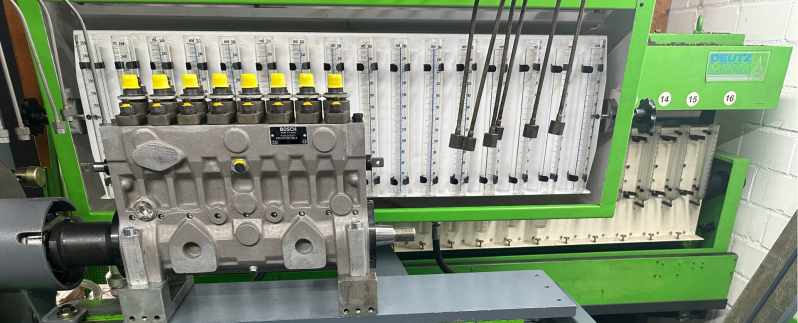
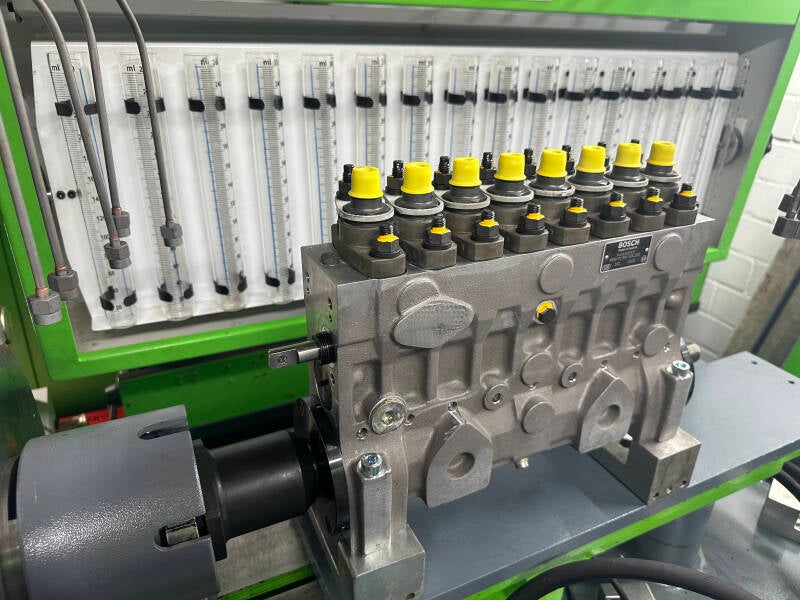
This reference project involved the complete inspection, overhaul and test-bench calibration of two mechanically coupled Bosch P10 inline fuel injection pumps from an MWM / Deutz TBD620 V16 marine engine.
The 16-cylinder engine is used as a marine main propulsion engine and produces approximately 1,800 kW at 1,500 rpm.
Unlike an injection system consisting of one single pump, this TBD620 V16 uses two eight-cylinder Bosch P10 injection pumps which are mechanically coupled in the engine and together provide fuel delivery for all 16 cylinders.
The system consists of the following two pump configurations:
Front Bosch P10 Injection Pump
Bosch type: PE8/10/150/100LS50
Bosch part number: 9 410 365 828
Alternative Bosch number: 9410365828
MWM / Deutz part number: 12302170
Alternative search and documentation formats:
1230 2170
1230-2170
Rear Bosch P10 Injection Pump
Bosch type: PE8/10/150/100LS51
Bosch part number: 9 410 365 829
Alternative Bosch number: 9410365829
MWM / Deutz part number: 12302171
Alternative search and documentation formats:
1230 2171
1230-2171
Although the LS50 and LS51 pumps are closely related, they must be treated as precisely defined individual pump versions.
External similarity does not make Bosch P10 pumps automatically interchangeable, nor does it mean that different versions can be calibrated according to the same specification.
Correct identification must always consider the complete Bosch type designation, Bosch part number, MWM / Deutz reference and corresponding engine data.
Initial Problem: Fuel Dilution of the Engine Oil
The injection system was investigated after repeated engine-oil analyses showed an increasing level of fuel dilution in the lubricating oil.
Fuel contamination of engine oil in a large diesel engine must be taken seriously.
An increasing proportion of diesel fuel can affect oil viscosity and consequently the lubrication conditions of bearings, cylinder components and other mechanically loaded parts.
However, fuel dilution in engine oil should never automatically be attributed to the injection pump alone.
The complete system must be considered during fault diagnosis, including possible influences from:
-
fuel injection pumps
-
injectors and nozzle holders
-
fuel supply system
-
combustion condition
-
cylinder condition
-
operating profile
-
and other engine-related causes
In this particular project, the subsequent complete dismantling of both Bosch P10 injection pumps revealed substantial wear in several precision and drive-related components.
Technical Findings After Dismantling
Both Bosch P10 pumps were completely dismantled and thoroughly cleaned before the individual components were inspected for wear, dimensional condition and suitability for continued operation.
Significant wear was identified.
The affected components included in particular:
-
all pumping elements
-
all delivery valves
-
all tappets
-
several control sleeves
The existing pumping elements were no longer suitable for a technically complete overhaul and reliable continued operation.
All delivery valves and tappets were also replaced due to their wear condition.
Several control sleeves showed excessive wear and also had to be renewed.
This project demonstrates an important principle when overhauling large mechanical fuel injection pumps:
Replacing seals alone is not equivalent to a complete injection-pump overhaul.
A pump can be externally dry and mechanically movable while critical internal precision components are already substantially worn.
The actual condition can only be determined after systematic dismantling, cleaning, measurement and inspection.
Complete Overhaul of Both Bosch P10 Injection Pumps
After the technical assessment, both pumps underwent a complete mechanical overhaul.
The work included:
-
complete technical identification
-
documentation of the incoming condition
-
complete dismantling
-
thorough cleaning of all relevant assemblies
-
dimensional inspection of precision components
-
inspection of the pump housings
-
inspection of the camshafts
-
inspection of bearing positions
-
inspection of roller and tappet mechanisms
-
inspection of the control racks
-
inspection of the control sleeves
-
assessment of all pumping elements
-
assessment of all delivery valves
-
inspection of drive components
-
replacement of all required seals
-
replacement of worn components
-
complete mechanical rebuilding
-
internal basic adjustment
-
individual testing of each injection pump
-
individual fuel-delivery calibration
-
mechanical coupling of both pumps
-
complete tandem test-bench operation
-
final correction of both pumps as one system
-
and final system verification
In this particular project, the overhaul required replacement of:
all pumping elements
all delivery valves
all tappets
and
several worn control sleeves
The objective was not merely to restore basic operation.
The objective was to rebuild both pumps as a technically coordinated injection system suitable for continued operation on the corresponding TBD620 V16 engine.
Calibration Using Bosch Test Data and Engine Acceptance Data
After mechanical rebuilding, both Bosch P10 pumps were initially calibrated independently on the test bench.
For this project, the technical basis included both:
original Bosch test data
and
engine acceptance data
This is particularly valuable when working with historical large-engine injection systems.
A Bosch P10 pump cannot be correctly calibrated simply according to the general designation “P10”.
Even pumps with very similar external dimensions can differ in:
-
pumping-element specification
-
camshaft configuration
-
fuel-delivery characteristics
-
rated pump speed
-
engine power
-
basic adjustment
-
control characteristics
-
and application-specific calibration
For this reason, the following information is always considered together:
Bosch pump type + Bosch part number + MWM / Deutz part number + engine application
Individual Test of Bosch PE8/10/150/100LS50 – 12302170
The front pump of this TBD620 V16 injection system is:
Bosch P10 PE8/10/150/100LS50
Bosch 9 410 365 828
Bosch 9410365828
MWM / Deutz 12302170
MWM / Deutz 1230 2170
MWM / Deutz 1230-2170
During individual test-bench calibration, all eight pumping elements are evaluated separately.
Depending on the applicable test specification, the assessment can include:
-
fuel delivery of each individual pumping element
-
uniformity between all eight pump sections
-
fuel delivery at defined test speeds
-
repeatability of measured delivery quantities
-
control-rack movement
-
internal basic adjustment
-
external leakage
-
and mechanical running behaviour
Graduated measuring cylinders allow the fuel quantity from each pumping element to be measured individually.
For a large diesel injection pump, total fuel delivery alone is therefore not sufficient.
The distribution of fuel between the individual cylinders is equally important.
The objective is to achieve reproducible fuel delivery within the applicable technical tolerances.
Individual Test of Bosch PE8/10/150/100LS51 – 12302171
The second pump of the system is:
Bosch P10 PE8/10/150/100LS51
Bosch 9 410 365 829
Bosch 9410365829
MWM / Deutz 12302171
MWM / Deutz 1230 2171
MWM / Deutz 1230-2171
This pump was also completely overhauled and calibrated independently before both pumps were mechanically coupled for the final system test.
This individual calibration is necessary because each eight-cylinder pump must first operate correctly according to its own specification.
However, for this V16 application, individual calibration represents only the first stage of the final adjustment process.
Two Bosch P10 Pumps Form One V16 Fuel Injection System
On this MWM / Deutz TBD620 V16, the pumps
12302170 / PE8/10/150/100LS50
and
12302171 / PE8/10/150/100LS51
do not operate as two completely independent units.
The two pumps are mechanically connected.
A coupling shaft between the injection pumps links the two pump assemblies mechanically.
Together, they provide the fuel injection supply for the complete 16-cylinder engine.
For this reason, we do not regard this arrangement simply as:
two independent eight-cylinder injection pumps
but as:
one mechanically coupled V16 fuel injection system.
This distinction is technically important for the final calibration.
Why Individual Calibration Alone Is Not Sufficient
Both P10 injection pumps were initially calibrated separately.
After individual calibration, each pump fulfilled the relevant requirements when tested independently.
At this stage, both pumps could have been considered correctly adjusted when evaluated as individual units.
However, the work on the complete injection system was not finished.
A correctly calibrated individual injection pump is not automatically perfectly matched to its mechanically coupled partner pump.
This difference became clearly visible during the final tandem test in this project.
Tandem Test of Bosch P10 Pumps 12302170 and 12302171
After individual calibration, both overhauled pumps were mechanically connected and operated together as one complete pump tandem.
This allowed the behaviour of the entire TBD620 V16 injection system to be assessed under common mechanical operation.
Our dedicated large-engine injection-pump test bench provides 16 separate graduated measuring cylinders for this purpose.
This makes it possible to evaluate simultaneously:
-
all eight pumping elements of the 12302170 pump
-
all eight pumping elements of the 12302171 pump
-
delivery uniformity within the front pump
-
delivery uniformity within the rear pump
-
the relationship between both pumps
-
fuel distribution across all 16 pumping elements
-
repeatability of the delivery quantities
-
and behaviour under common mechanical coupling
The result is substantially more informative than evaluating two eight-cylinder pumps completely independently.
Both Pumps Required Additional Correction During Tandem Operation
This project produced a particularly important technical finding.
Although both Bosch P10 pumps had already been correctly calibrated individually, additional corrections were required once they were operated together as a mechanically coupled tandem system.
This is precisely where the technical value of the combined 16-cylinder test becomes apparent.
Individual calibration can verify that:
pump 12302170 operates correctly as an individual eight-cylinder injection pump
and that:
pump 12302171 operates correctly as an individual eight-cylinder injection pump.
The tandem test answers a different question:
How do both pumps operate together as the complete fuel injection system of the TBD620 V16?
Only during mechanically coupled operation could the remaining differences between both units be identified and corrected.
After these final adjustments, the complete tandem system was tested again.
Why Tandem Calibration Matters on a TBD620 V16
Over many operating hours, two mechanically coupled injection pumps can develop differently.
Possible influences include:
-
different wear conditions
-
manufacturing and component tolerances
-
previous repairs carried out at different times
-
previously replaced pumping elements
-
different control-sleeve wear
-
changes made during earlier adjustments
-
coupling tolerances
-
differences in control-rack travel
-
and differences in internal basic settings
Even after a complete mechanical overhaul and precise individual calibration, these factors can influence how both pumps interact as one complete system.
The final tandem test is therefore an important additional verification step for this type of mechanically coupled V16 injection system.
In this reference project, its value was demonstrated directly:
both pumps required further correction during combined operation despite having previously passed their individual calibration.
Testing the Complete 16-Cylinder Injection System
With our dedicated test equipment, the complete pump tandem can be evaluated across 16 measuring positions simultaneously.
This allows direct comparison of fuel delivery for the complete 16-cylinder injection system.
The objective is not merely to produce:
one correctly calibrated front eight-cylinder pump
and
one correctly calibrated rear eight-cylinder pump.
The objective is to achieve:
a technically coordinated and uniform fuel supply for the complete 16-cylinder engine.
For a marine main propulsion engine producing approximately 1,800 kW, this balance is particularly important.
Differences in fuel delivery can influence:
-
individual cylinder output
-
exhaust-gas temperature
-
thermal loading
-
smoke behaviour
-
engine running characteristics
-
fuel consumption
-
and load distribution between cylinders
Accurate calibration therefore concerns more than the injection pump itself.
It contributes to the operating condition of the complete engine.
From Two Injection Pumps to One Calibrated V16 System
This project demonstrates the difference between repairing individual components and understanding the complete fuel injection system.
The process involved:
diagnosis
→ complete dismantling
→ dimensional inspection
→ replacement of worn precision components
→ mechanical rebuilding
→ individual calibration of 12302170
→ individual calibration of 12302171
→ mechanical coupling
→ 16-cylinder tandem testing
→ additional correction
→ final system verification
This final step is particularly important.
Despite successful individual calibration of both Bosch P10 pumps, the coupled tandem test revealed that both units still required correction.
Only the combined 16-cylinder test allowed the complete TBD620 V16 injection system to be finally coordinated.
Bosch P10 PE8/10/150/100LS50 – MWM / Deutz 12302170
For technical identification, spare-parts enquiries and international search systems, the front injection pump can be referenced using the following numbers:
Bosch P10
PE8/10/150/100LS50
9 410 365 828
9410365828
MWM / Deutz 12302170
MWM / Deutz 1230 2170
MWM / Deutz 1230-2170
Different formatting of the same historical reference is common in:
-
ERP systems
-
spare-parts databases
-
workshop documentation
-
engine records
-
inventory lists
-
purchasing systems
-
and online searches
Using the complete Bosch and MWM / Deutz information helps prevent incorrect identification.
Bosch P10 PE8/10/150/100LS51 – MWM / Deutz 12302171
The rear injection pump can be identified as:
Bosch P10
PE8/10/150/100LS51
9 410 365 829
9410365829
MWM / Deutz 12302171
MWM / Deutz 1230 2171
MWM / Deutz 1230-2171
The LS50 and LS51 suffixes are technically relevant parts of the complete Bosch pump designation.
They should not be ignored when identifying a pump, sourcing components or determining the correct test and calibration specification.
Information for Maintenance Engineers and Workshops
If you are responsible for the technical maintenance of an MWM / Deutz TBD620 V16, the most useful information for an initial assessment is:
-
complete Bosch pump type
-
Bosch part number
-
MWM / Deutz part number
-
engine designation
-
engine serial number
-
engine output and rated speed
-
application
-
operating symptoms
-
oil-analysis results where relevant
-
previous pump repair history
-
and clear photographs of both injection pumps and identification plates
For a V16 tandem system, the identification data of both injection pumps should be provided whenever possible.
This allows the relationship between the two pump versions to be evaluated from the beginning.
Information for Technical Procurement and Spare-Parts Departments
For procurement teams, these pumps may appear in historical documentation only under an OEM or Bosch reference.
Relevant search combinations include:
MWM / Deutz 12302170
Deutz 1230 2170
Bosch 9 410 365 828
Bosch 9410365828
Bosch PE8/10/150/100LS50
and:
MWM / Deutz 12302171
Deutz 1230 2171
Bosch 9 410 365 829
Bosch 9410365829
Bosch PE8/10/150/100LS51
Where complete new replacement pumps are difficult to source, overhaul of the existing original injection system can provide an alternative to searching indefinitely for increasingly scarce replacement units.
For operators of long-life marine and industrial engines, this can form part of a broader obsolescence-management and asset-life-extension strategy.
Information for Marine Superintendents and Technical Management
For a vessel operator or technical manager, the most important issue is usually not the injection pump as an isolated component.
The real questions are:
-
Can the existing main engine remain reliably in operation?
-
Can an existing original injection system be retained?
-
Can future unplanned downtime be reduced?
-
Should both pumps be overhauled as a matched system?
-
Is a spare pump pair available and should it be prepared preventively?
-
Are critical components becoming obsolete?
-
Can the service life of the existing engine installation be extended?
For mechanically coupled V16 injection systems, both pumps should therefore be considered together when planning maintenance.
International Repair Service for Bosch P10 12302170 and 12302171
Einspritzpumpen Manufaktur NRW in Germany supports international operators, engine workshops, marine service companies and technical purchasing departments with the inspection, overhaul and calibration of historical Bosch mechanical injection systems.
Enquiries concerning:
Bosch P10 PE8/10/150/100LS50
Bosch 9 410 365 828
MWM / Deutz 12302170
and
Bosch P10 PE8/10/150/100LS51
Bosch 9 410 365 829
MWM / Deutz 12302171
can be assessed using the complete pump and engine information.
For a TBD620 V16 application, please provide information for both injection pumps whenever possible.
Technical Enquiry – Bosch P10 TBD620 V16
For an initial technical assessment, please send:
-
clear photographs of both injection pumps
-
photographs of both Bosch identification plates
-
Bosch pump type numbers
-
Bosch part numbers
-
MWM / Deutz part numbers
-
complete engine designation
-
engine output and rated speed
-
application of the engine
-
description of the operating problem
-
available maintenance, oil-analysis or repair information
For international shipments, please contact us before dispatch so that the repair shipment and return delivery can be correctly coordinated.
Bosch P10 12302170 & 12302171 – Specialist Overhaul for MWM / Deutz TBD620 V16
The Bosch P10 pumps 12302170 / PE8/10/150/100LS50 and 12302171 / PE8/10/150/100LS51 can form one mechanically coupled injection system on an MWM / Deutz TBD620 V16.
This reference project demonstrates why a complete overhaul of such a system should extend beyond replacing seals or independently adjusting two injection pumps.
Both pumps were:
-
completely dismantled
-
inspected and measured
-
rebuilt with the required replacement components
-
calibrated individually
-
mechanically coupled
-
tested across 16 measuring positions
-
corrected during tandem operation
-
and finally verified as one complete V16 fuel injection system
The decisive result of this project was clear: although both Bosch P10 pumps fulfilled their individual calibration requirements, both required additional correction during the coupled tandem test.
For a mechanically linked TBD620 V16 injection system, the final objective is therefore not simply two correctly adjusted eight-cylinder pumps.
The objective is a technically coordinated 16-cylinder fuel injection system.